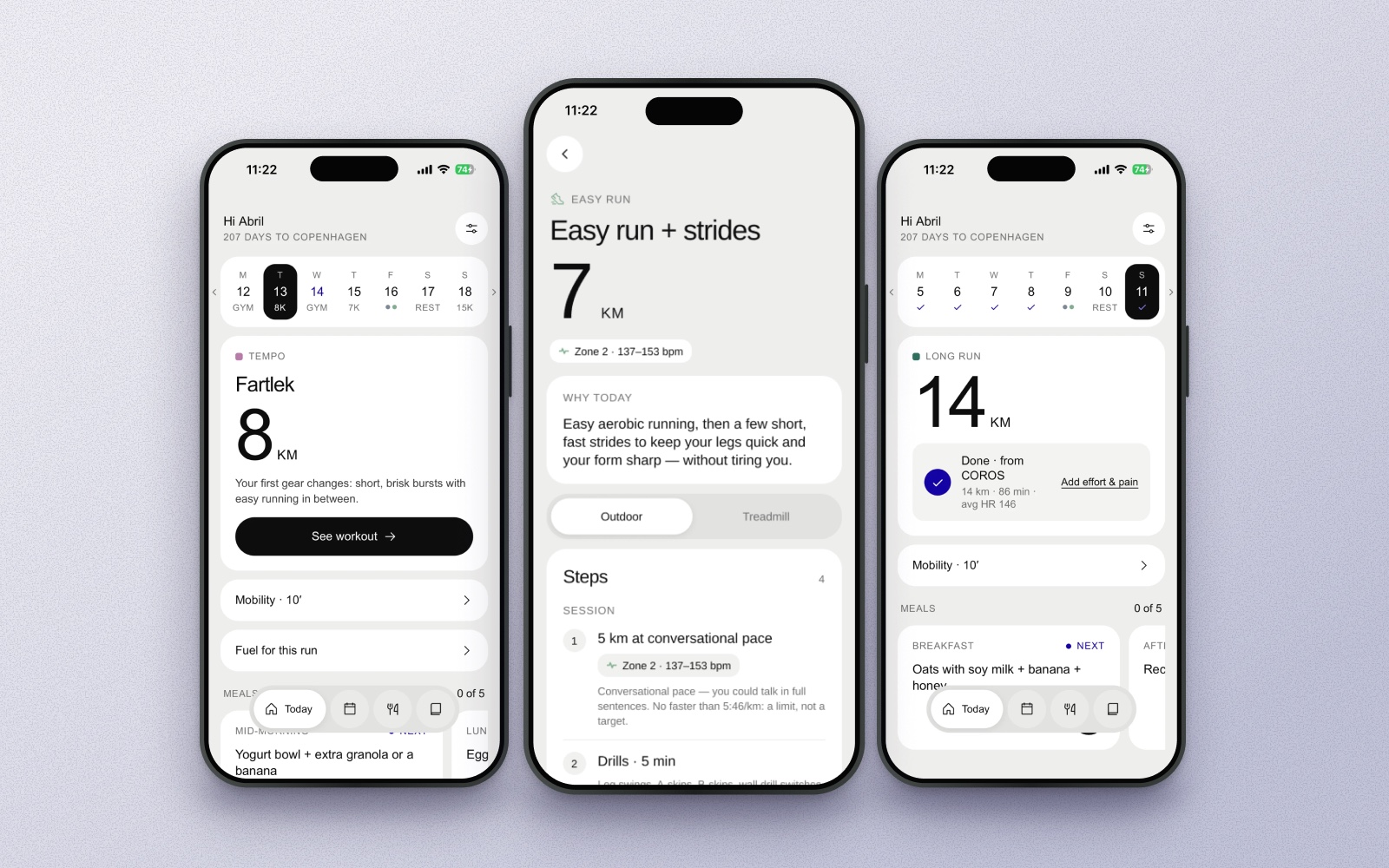
One question every morning: what do I do today?
Galgo is the training app I built for my first marathon, Copenhagen, May 2027. I designed it, built it with Claude Code, connected it to my watch and shipped it on Vercel. I open it every morning.
01 · The problem
A 259-day plan, and nowhere good to read it.
My coach built me a plan from September to race day: every run with its pace and heart-rate zone, gym sessions that change by phase, mobility, and how much to eat around each workout. It lived in spreadsheets and messages.
Every morning I had to piece together the same answer from four places. Running apps track what you did; none of them told me what to do today, from my coach’s plan.
02 · One job
The app answers one question in under three seconds.
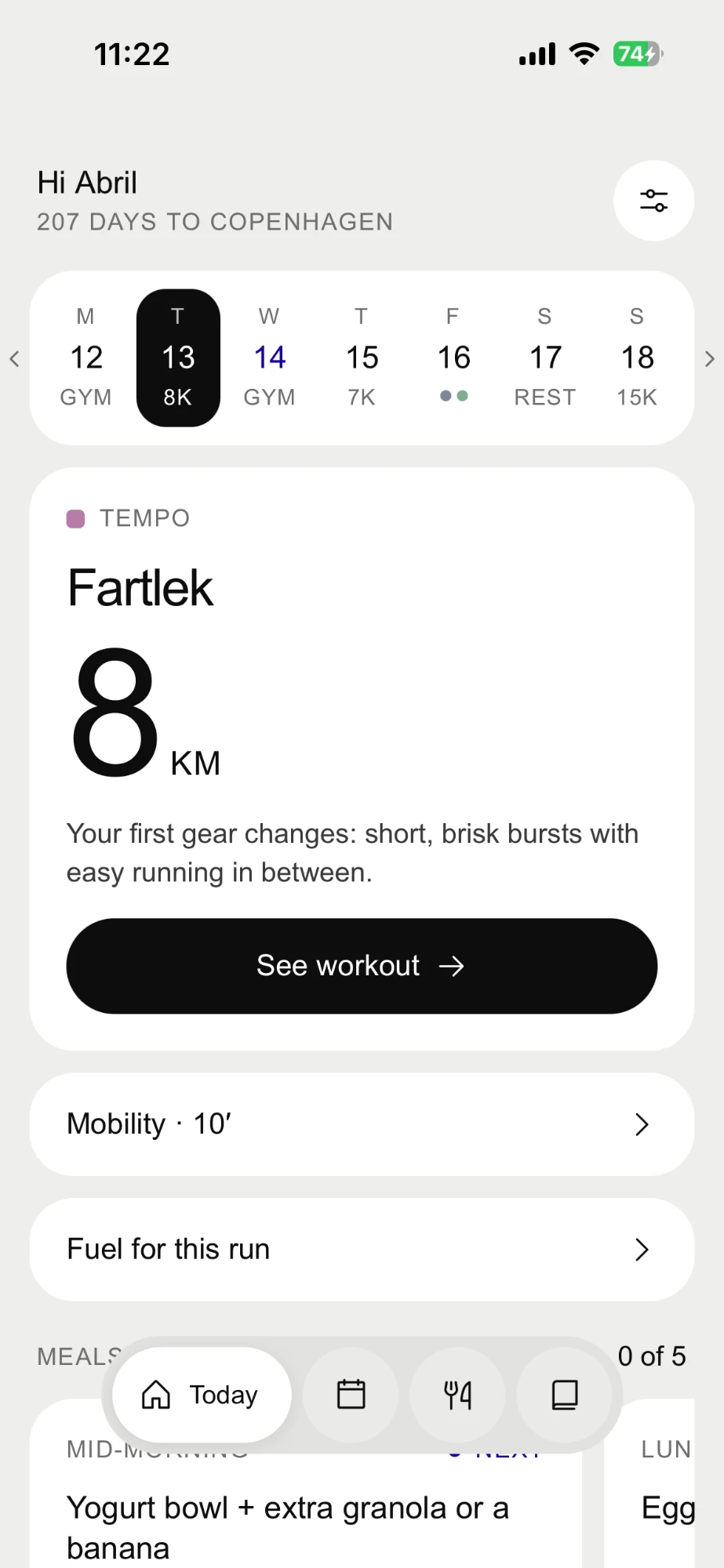
That one rule decided everything else. Today opens on the workout: one big number, what it’s for, and one button. Gym, mobility and meals sit below it, never above.
Colour is a signal, not decoration: blue means today and done, amber means heat, red only appears when I log pain. A high-contrast “Sun” mode keeps it readable outside at noon, and there are no session times, because I decide when I train.
03 · The watch
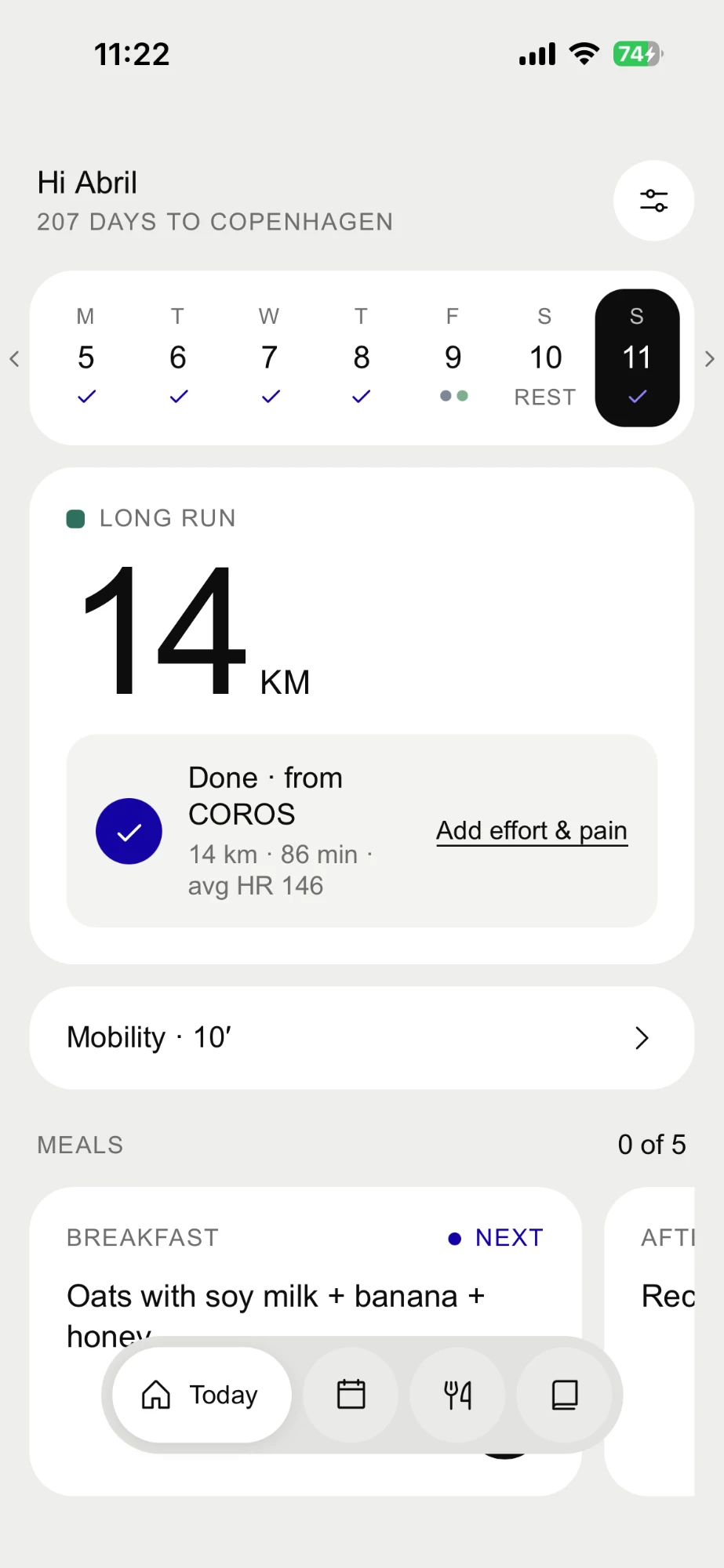
I stopped typing my runs: Galgo reads them from my watch.
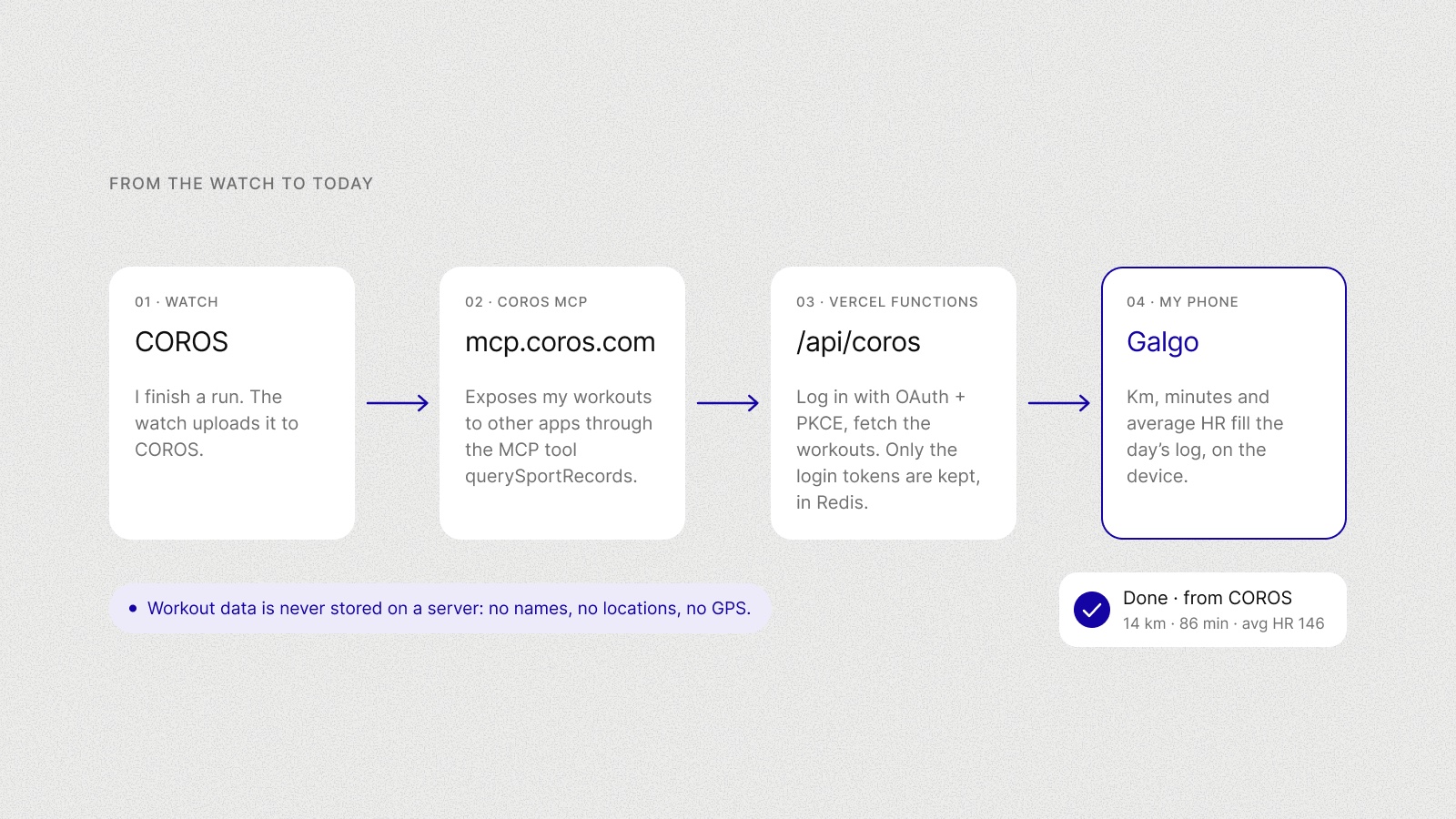
Logging every run by hand was the step I kept skipping. COROS has an MCP server — the same protocol AI tools use to talk to other apps — so I used it as an API: two small Vercel functions handle the login and fetch my workouts, and the phone fills in the day.
Privacy was a product decision, not an afterthought. The only thing stored on a server is the login token. Workouts go straight into the log on my phone, without names, locations or GPS.
04 · The heat
Córdoba summers are hot, so the app checks the weather for me.
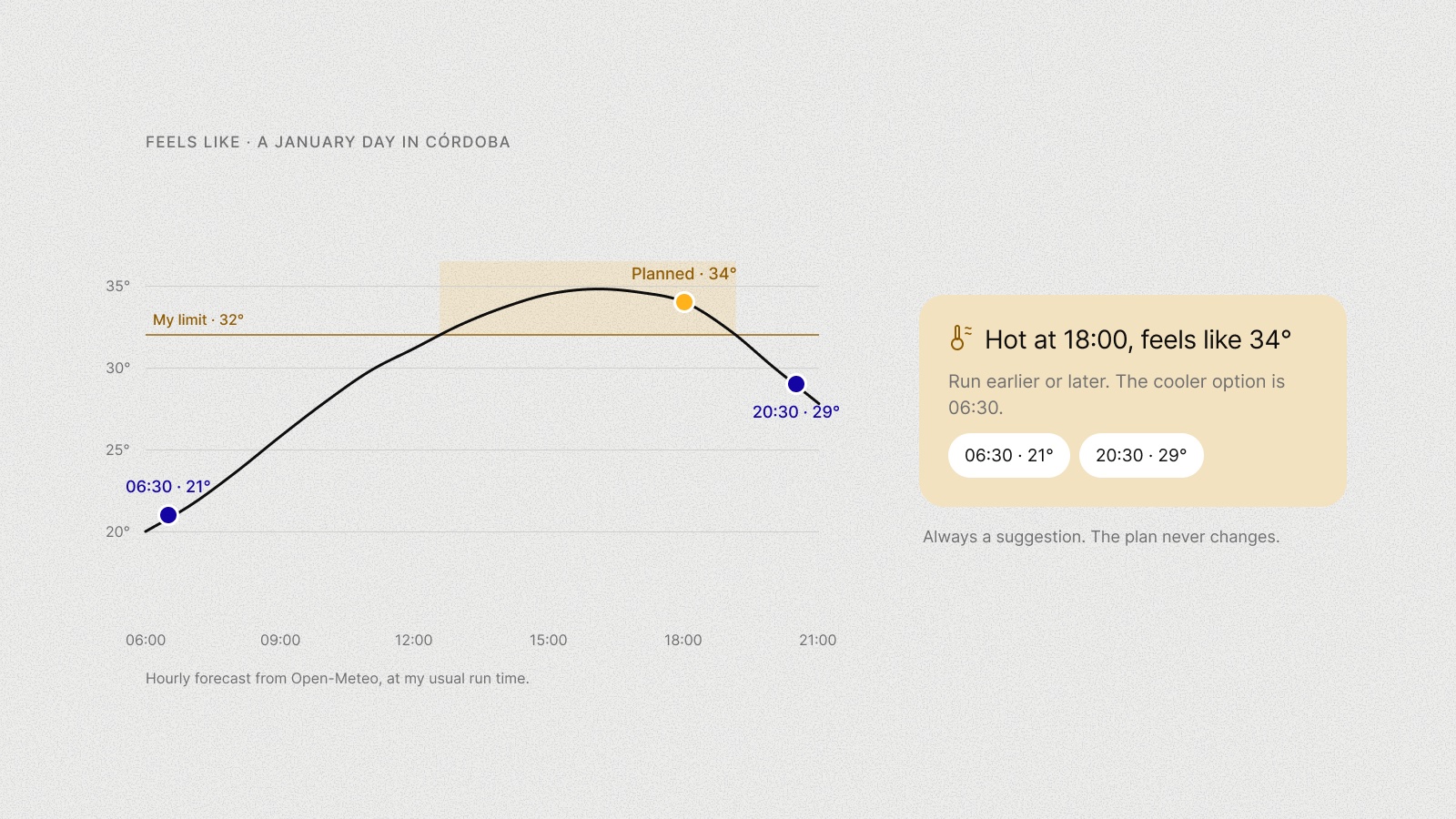
Most of my training happens in an Argentine summer. Galgo reads the hourly “feels like” from Open-Meteo for the time I usually run. Over my limit, it suggests what my coach would: run earlier, split a long easy run, or take a quality session to the treadmill.
It’s always a suggestion. The plan never changes on its own.
05 · Built with AI
I wrote the brief. Claude Code wrote the code. I checked every screen against my design.
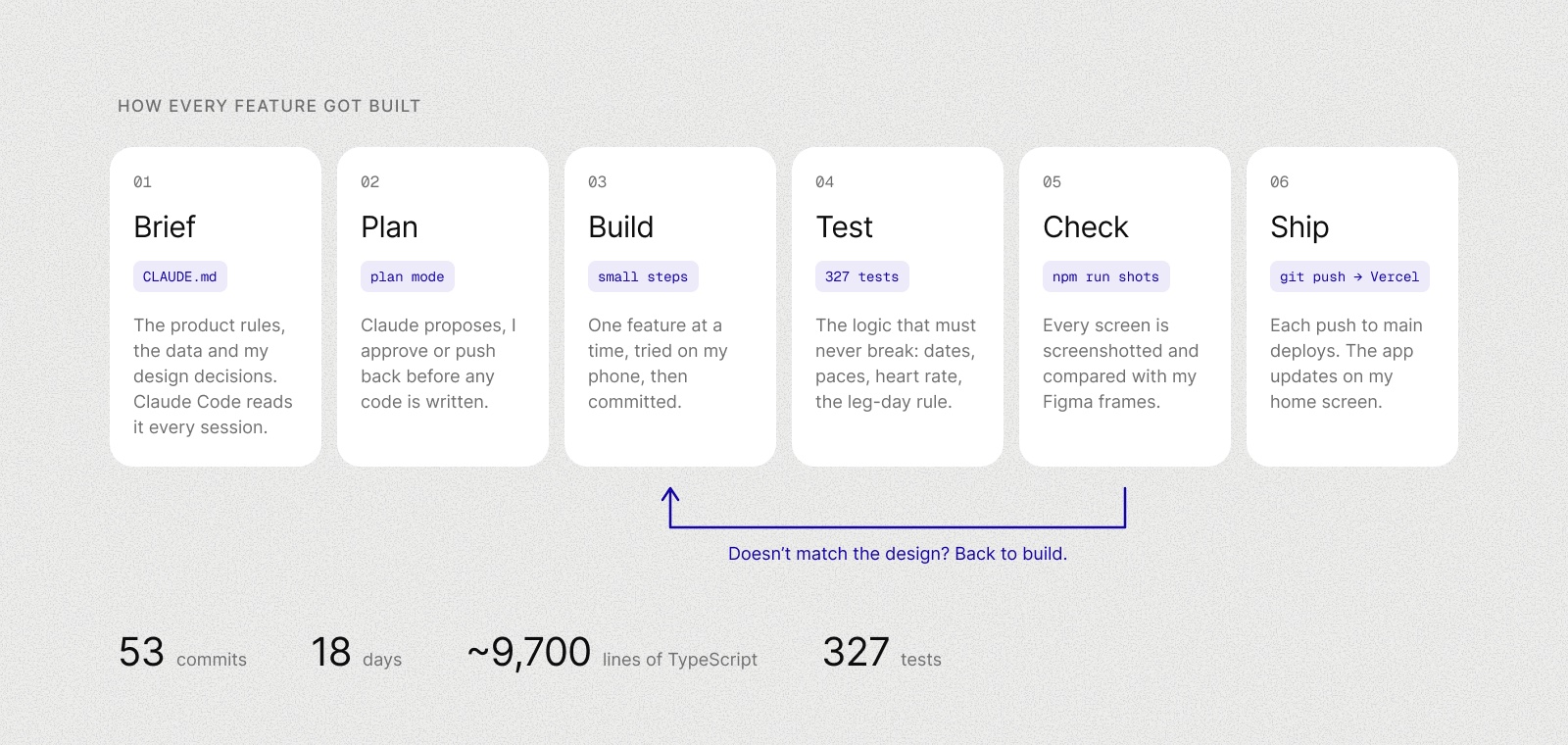
The core of the project is a CLAUDE.md file: the product’s rules, the data model and every design decision I made along the way. It’s a product spec written for an engineer that reads it at the start of every session.
I worked in small steps — plan, build, try it on my phone, commit — with tests for the logic that can’t break, like dates and heart-rate zones. And because I’m a designer, I added one more step: a script that screenshots every screen and diffs it against my Figma frames, so the build matches the design, not just roughly.
06 · The brand
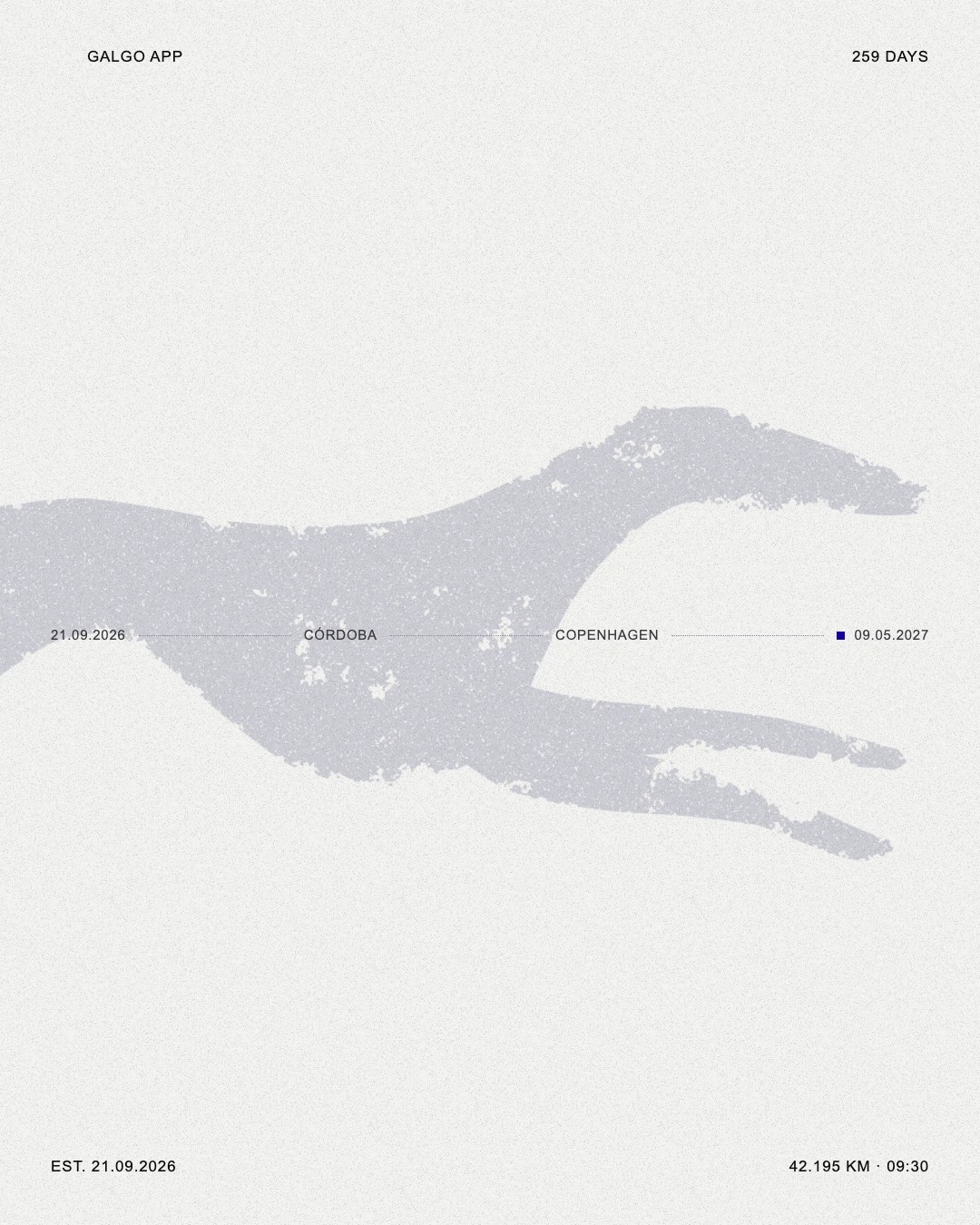
A greyhound, because it’s built for distance.
Galgo is Spanish for greyhound. I gave a personal tool a full identity — posters, a launch film and a season — because the details are what make you want to open it at 6 a.m.
07 · Outcome
I use it every morning.
Galgo is live on my home screen and runs my training: what to do, how it went, what to eat, and when it’s too hot. The real test is in May, in Copenhagen.
What it taught me: with AI, the bottleneck moves from writing code to deciding what to build and checking that it’s right. That’s product design.
- 18
- Days to build
- 327
- Tests
- Daily
- Real use